WhatsApp Business API Pricing in Sri Lanka: What Small Businesses Actually Pay (2026 Update)
What small businesses in Sri Lanka actually pay for the WhatsApp Business API after Meta’s 1 October 2026 pricing change — message types, free allowance, and how to estimate your bill in rupees.

If you run a small business in Sri Lanka, WhatsApp is probably already your busiest sales channel. Customers ask for prices, send payment slips and check on deliveries there all day. Sooner or later someone tells you to “move to the WhatsApp API”, and the first question is always the same: how much will it cost?
The honest answer is that there are two separate costs. One is what Meta (the company behind WhatsApp) charges for each message. The other is what your provider charges for setup, the software and support. This guide explains both in plain language, including the pricing change Meta made on 1 October 2026, so you can estimate your monthly bill before you commit.
WhatsApp Business app vs WhatsApp Business API: do you even need to pay?
The free WhatsApp Business app is fine when one or two people reply by hand from a phone. You get a business profile, a catalogue, quick replies and labels, and you pay nothing per message.
You need the API (Meta calls it the WhatsApp Business Platform) when:
- several staff need to answer from the same number at the same time,
- you want order, delivery or payment updates to go out automatically from your website or system,
- you want a chatbot to handle common questions after hours, or
- you send approved messages to a large list of customers who opted in.
If none of that applies yet, stay on the free app. The API only makes sense when the time it saves is worth more than the message charges.
How Meta charges for WhatsApp API messages
Meta charges per delivered message, and the price depends on two things: the type of message and the country of the person receiving it. Messages your customers send you are free.
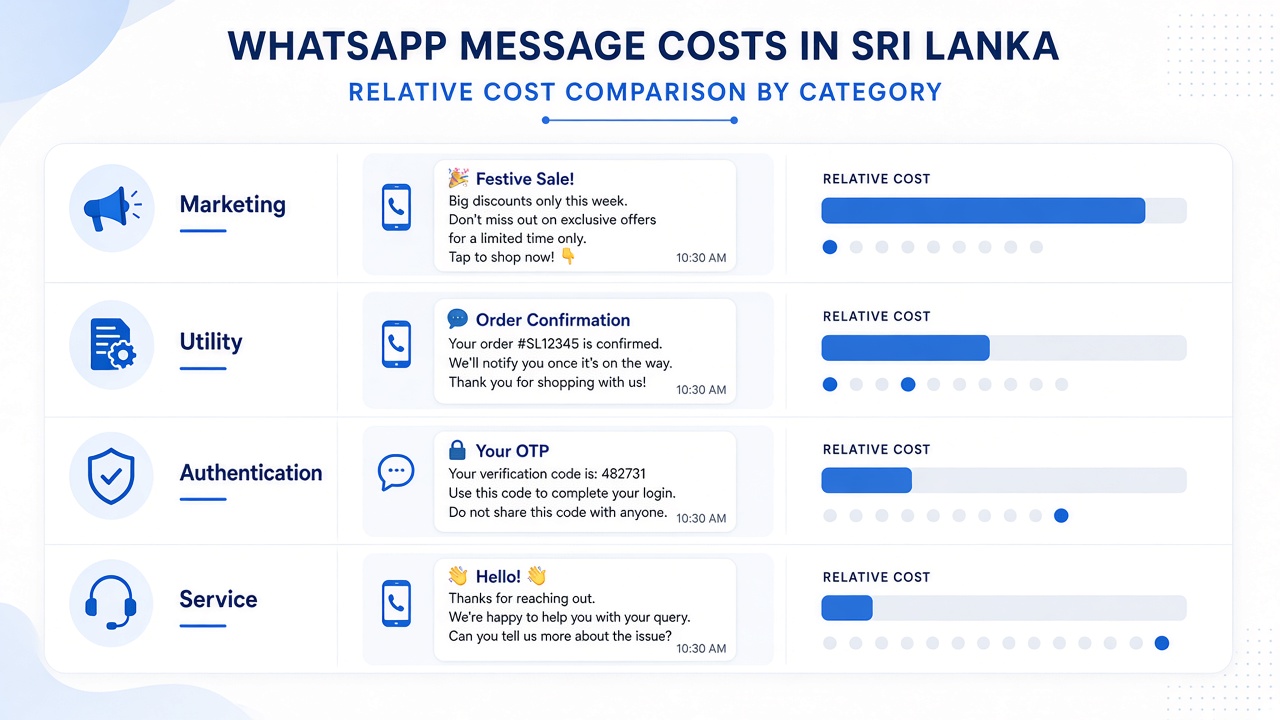
There are four message types to know.
1. Marketing messages. Offers, new arrivals, festive sale announcements and “we miss you” nudges. These are pre-approved templates and they are the most expensive type.
2. Utility messages. Order confirmations, delivery updates, payment reminders and appointment reminders. Also pre-approved templates, but much cheaper than marketing.
3. Authentication messages. One-time passwords for login or checkout. Priced close to utility messages.
4. Service messages. Your normal free-form replies when a customer messages you first. You can only send these inside the 24-hour customer service window, which opens (and resets) every time the customer writes to you.
Meta publishes its rates in US dollars. Sri Lanka doesn’t have its own line on the rate card, so Sri Lankan numbers are billed under the regional “Rest of Asia Pacific” rates. Because the price is in dollars, your rupee cost moves a little with the exchange rate.
What changed on 1 October 2026
Until recently, replying to customers was free. From 1 October 2026, Meta started charging for two things that used to cost nothing:
- Service replies inside the 24-hour window are now charged per message, at the same rate as utility messages. Each business number still gets a free monthly allowance of service messages (1,000 at the time of writing), which doesn’t carry over to the next month.
- Utility templates sent inside an open 24-hour window are now charged too. Before this, an order confirmation sent while the customer was mid-chat was free.
For most small businesses in Sri Lanka, the free allowance covers a good part of the everyday chat. The change matters most if your team handles thousands of customer conversations a month, for example a busy online store during the Avurudu or Christmas season.
The free messages you can still use
Two things still cost nothing:
- Customer messages to you. Every incoming message is free.
- Click-to-WhatsApp ads. When a customer taps a Facebook or Instagram ad (or a Facebook Page button) that opens a WhatsApp chat on their phone, and you reply in time, a 72-hour free window opens. Messages you send in that window, including templates, aren’t charged.
If you already run Meta ads, pointing them to WhatsApp is one of the easiest ways to keep message costs down.
Your provider’s costs
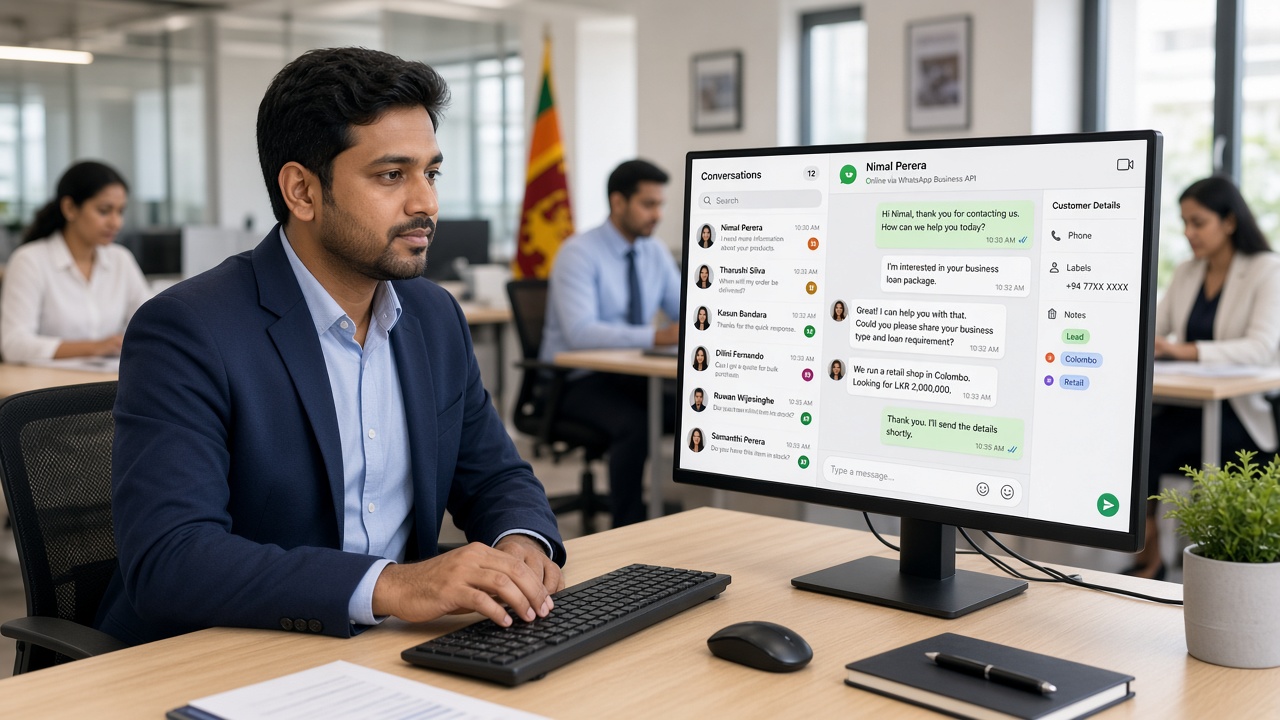
Meta doesn’t sell the API directly to most small businesses. You go through a provider who connects your number, gives your team a shared inbox and keeps everything running. That usually means:
- A one-off setup fee for business verification, connecting your number and writing your first message templates.
- A monthly fee for the inbox, chatbot, integrations and support.
- Message charges, passed on from Meta.
When you compare providers, ask whether message charges are passed on at Meta’s rate or marked up, and whether you’ll see an estimate in rupees before you start.
A worked example (illustrative only)
Here’s how a typical month might look for a small services firm in Kandy. This is example data to show the method, not real prices.
- The firm sends 800 appointment reminders. Those are utility messages, charged per message.
- Clients send 1,500 messages asking about appointments and fees. Incoming messages are free.
- The team and a chatbot send 1,300 replies inside the 24-hour window. The first 1,000 are covered by the free allowance, and the other 300 are charged at the service rate.
- The firm sends no marketing messages this month, so that cost is zero.
So the bill is 800 utility messages plus 300 service messages, multiplied by the current Rest of Asia Pacific rates, plus the provider’s monthly fee. A small retailer that sends a festive offer to 5,000 customers would see a very different bill, because all 5,000 are marketing messages.
Five ways to keep your WhatsApp API bill low
- Use utility messages for what is genuinely utility. Order and delivery updates are cheaper than marketing, but Meta reviews templates, and a promotion dressed up as an update can be re-categorised as marketing.
- Send fewer, better marketing messages. One well-timed offer to customers who bought before beats a weekly blast to everyone.
- Let a chatbot answer the repeat questions. Fewer back-and-forth messages per customer means fewer charged replies once you pass the free allowance.
- Run Click-to-WhatsApp ads so new enquiries start in a free 72-hour window.
- Clean your list. Remove numbers that never open or reply. You pay for delivered messages, so dead contacts still cost you.
How Digital Urgency WhatsApp API is priced
DU WhatsApp API comes in Standard, Premium and Enterprise tiers, depending on how many team members, automations and integrations you need. Each includes setup, template writing and support, with Meta’s message charges on top.
Prices depend on your volumes, so we work it out with you: Request a quote and we’ll send a clear monthly estimate in rupees, split into our fee and the expected message charges. See what’s included on the Digital Urgency WhatsApp API page.
If you want automated replies from day one, the Digital Urgency AI Chatbot can answer common questions on WhatsApp and hand anything tricky to your team. And if you want WhatsApp tied into a full enquiry-to-sale workflow, take a look at Lead Machine.
Quick answers
Is the WhatsApp Business API free in Sri Lanka?
No. Meta charges per delivered message (except incoming messages and messages in a free entry window), and providers charge for setup and the platform. The WhatsApp Business app on your phone stays free.
Do I pay when a customer messages me?
No. Incoming messages are always free. You pay for the messages you send.
Are replies to customers still free?
Not since 1 October 2026. Replies inside the 24-hour window are now charged after your monthly free allowance runs out.
Is pricing in rupees or dollars?
Meta sets its rates in US dollars. We give you the estimate in rupees so you know what to budget.
Can I keep my current number?
Often, yes, but a number can’t run on the WhatsApp app and the API at the same time unless it’s set up to support both. We’ll check your number before we start.
Ready to see your numbers? Request a quote for DU WhatsApp API and tell us roughly how many customers you message each month.
Want this done for your business?
Book a free 30-minute strategy call and we'll map it to your situation.
Book a Strategy Call